Replacing a flat or low-slope commercial roof in South Florida is one of the priciest capital decisions an HOA board or property manager will ever make. Full tear-off and replacement on a mid-size condo or clubhouse can easily hit $15 to $30 per square foot, depending on the system and the roof's current shape.
With numbers like that, more boards are asking a fair question: can a solid South Florida roof coating stretch out your roof's life without forcing an early, wallet-draining replacement?
It comes down to the roof's condition, the system you have, and whether you are matching the right coating chemistry to Florida's harsh climate.
The UV here is brutal, the rain is relentless, humidity rarely lets up, and salt air from the coast speeds up wear far faster than you would see up north. A coating that survives in the Midwest can fall apart after a few South Florida summers if it is not built for this climate.
So which coatings actually hold up here? How do you tell if your property is even a candidate for restoration? And what should boards weigh when comparing a coating investment against the risk of putting off replacement? Here is how the costs stack up, and what to ask any manufacturer before you sign off on a product.
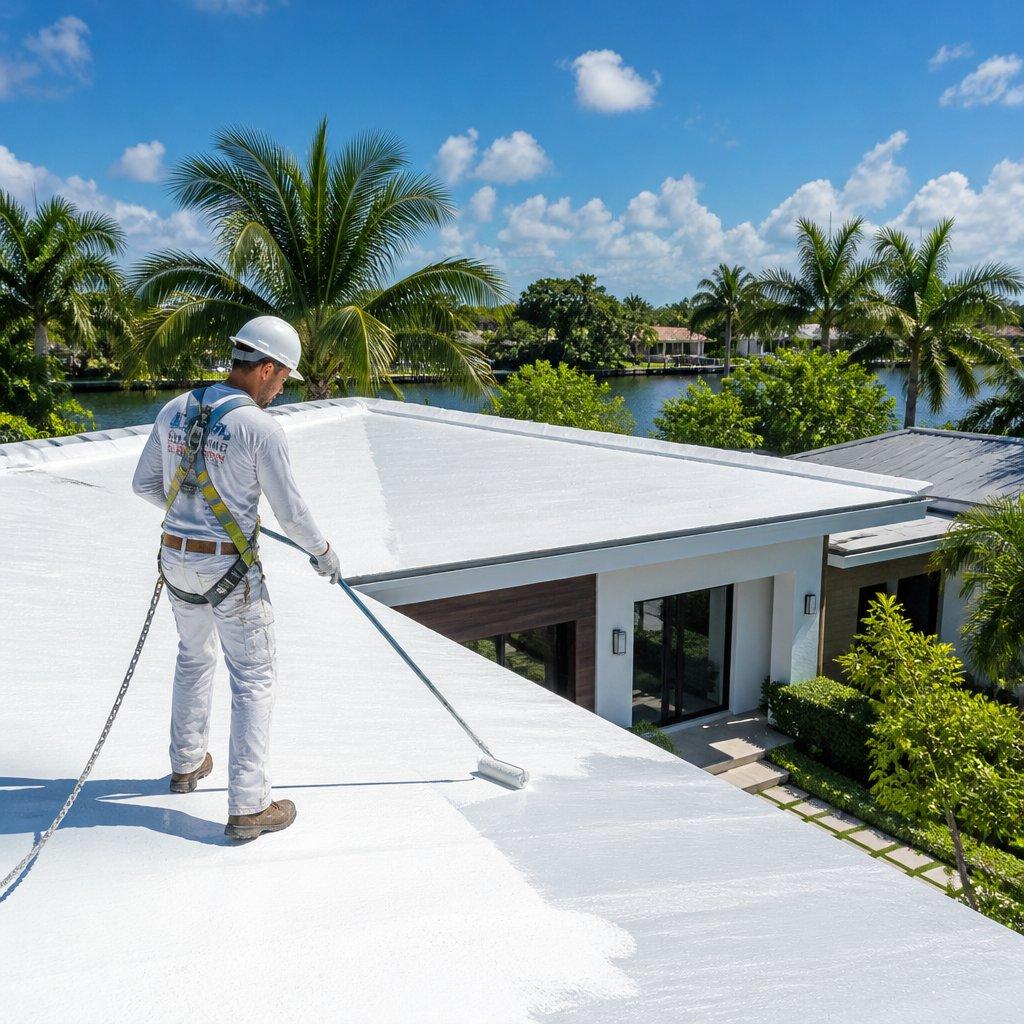
A roof coating is not just paint. It is a liquid-applied membrane, usually 20 to 30 mils thick once dry, that bonds to your existing roof and forms a continuous, waterproof, UV-reflective layer.
Unlike the spot sealants you brush onto seams or around vents, a full roof coating covers the whole deck. You get a barrier against water, protection from UV damage, and less heat radiating into the building. Work coatings into a regular maintenance plan and you can stretch the roof's life and skip the cost and disruption of a full tear-off for years.
White or light-colored roof coatings bounce back much of the sun's energy instead of soaking it in. Following how reflective roofs cut cooling costs, reflective roofs in hot climates can meaningfully lower peak cooling demand and surface temperatures compared with dark roofs.
Down here, a dark roof can hit 170°F on a sunny day. Lowering that surface temperature matters. A cooler roof goes through less of the expansion and contraction that eventually cracks seams and loosens the membrane. A reflective coating keeps that cycle in check and takes stress off the whole assembly.
South Florida gets more than 60 inches of rain a year, most of it packed into June through October. A good waterproofing coating seals the hairline cracks and seam gaps where water sneaks into aging flat roofs.
Elastomeric formulas stretch over those cracks and move with the deck as temperatures swing. That flexibility is a big deal in Florida, where a roof can bake at 95°F and then cool fast when a storm drops the temperature twenty degrees in minutes.
The logic is simple. If the deck is still solid and the membrane has not failed everywhere, a coating can restore waterproofing and UV protection at a fraction of replacement cost. Most estimates put a good coating job at about 20 to 40 percent of what you would pay to replace the whole system, depending on the roof's condition and how much patching it needs first.
On a 30,000 square foot clubhouse roof, that can be the difference between roughly $450,000 to replace and $90,000 to $180,000 to coat. You also skip the landfill fees from tearing off the old roof, cut labor, and keep the property open the whole time. Once you see what a coating can do, the next step is figuring out if your roof is a good candidate.
Restoration makes sense when the roof still has its bones, and the problems are mostly on the surface. You need a professional inspection to confirm, but there are signs any property manager can spot first. Often the first signal is not on the roof at all. It is the top-floor owner reporting a ceiling stain after the first hard August downpour.
Your flat or low-slope roof is probably a candidate if the deck feels solid, the insulation underneath has not been soaked over and over, and leaks trace back to obvious failed seams or penetrations rather than the whole field.
Modified bitumen, single-ply membranes like TPO or EPDM, and metal roofs can all take coatings when prepped right. A metal roof showing some rust but no structural damage is often perfect for a coating, because you can stop corrosion and buy years of life for far less than replacing panels.
Coat over an existing problem, and you are asking for trouble. Before you apply anything, fix:
Coating over wet insulation is a classic Florida mistake. Trapped moisture bubbles up and ruins the coating, sometimes within a season or two.
If the roof has outlived its design life and you are seeing major failure across nearly half the membrane, a coating is only a band-aid. Spending on it just delays the inevitable, and you will not get the warranty or performance of a new system.
The code can also force your hand. If code requires a full tear-off and replacement because of damage or too many existing layers, you have to do it. Knowing where your roof stands tells you which coating fits, if any.
Coating chemistry is not a detail. It is the difference between a roof that lasts and one that fails early. Most commercial and condo buildings here run flat or low-slope, but the membrane underneath drives which coating actually works.
Flat and low-slope roofs cover most condos, clubhouses, and commercial buildings in Broward and Palm Beach. They hold standing water more than pitched roofs, so waterproofing comes first. Liquid-applied coatings shine here because they erase the seams where water sneaks through.
Modified bitumen and single-ply membranes like TPO and EPDM are common on buildings from the 1980s through the 2000s. Old, oxidized bitumen responds well to elastomeric coatings that restore flexibility and reflectivity. Single-ply membranes need a coating matched to their chemistry, so confirm compatibility before you choose a product.
Elastomeric roof coatings, basically water-based acrylics, stretch and snap back as the roof moves. They do well on concrete, masonry, or modified bitumen that flexes with temperature swings but does not pond water for days.
Locally, elastomerics are popular on low-slope condo and clubhouse roofs because they reflect UV, resist mildew, and stay flexible. They also pair with exterior coatings built for salt, sun, and humidity, which matters in coastal spots from Fort Lauderdale to Boca Raton.
Silicone roof coatings earn their keep where ponding is a problem. Silicone does not absorb water, so it keeps adhering and flexing even when water sits on it for days after a storm.
If your flat roof drains poorly, silicone is usually the safer bet. The trade-off: silicone picks up dirt faster, so it loses reflectivity unless you wash it now and then. In this humidity, algae and mildew can also take hold unless the formula carries a mildew-fighter.
Metal roof coatings solve different problems than flat membrane systems. Salt air speeds rust on metal panels, and constant expansion and contraction widen fastener holes, letting leaks in.
A good metal roof coating stops leaks, reflects UV, and slows corrosion. If your standing-seam or corrugated metal roof is still structurally sound, restoration almost always beats replacing panels on cost. Picking the right system is one thing; timing the project for your budget and Florida's weather is another.
Even the best coating, applied at the wrong time, can cost more than it saves. Boards should weigh three things together: where the budget stands, the roof's leak history, and how the project will actually get done.
Coating in year 8 of a 20-year roof is a different decision than coating in year 16. The earlier you restore, the more years you get per dollar. Wait too long, and you are into emergency repairs, last-minute bids, and possibly interior damage claims that would have cost less if you had coated sooner.
HOA reserve studies should carry roof coating as its own maintenance line, not folded into the replacement reserve. Mixing the two usually means you underfund maintenance and raid the replacement fund too early.
Track leaks across at least two rainy seasons before you plan a coating project. If leaks return to the same spots, targeted repairs plus a coating can fix it. If new leaks appear every season, the membrane is probably failing across the field, not just in a few places.
A professional coating needs dry weather and warm-enough surfaces. In South Florida, late winter into early spring and again in October and November are your best windows, after hurricane season but before the holidays. Schedule outside those windows and you risk humidity or rain spoiling adhesion while the coating cures.
Coating a roof on a multi-unit property means coordinating access, moving HVAC covers, and warning residents about odors, especially with solvent-based primers. Water-based systems smell less, so they are easier on occupied buildings.
If you have rooftop equipment, amenities, or lots of penetrations, you will need a detailed scope before you get a price. Boards that plan these logistics avoid mid-project surprises and extra labor. The right contractor and a real manufacturer relationship make the difference.
A coating is only as good as the product and the crew applying it. Generic products and unvetted contractors are the top reasons coating projects fail in Florida's climate.
A real factory-direct consultation looks at your roof's substrate, condition, drainage, and exactly how much sun and moisture the building takes. You should walk away with a written product spec that names the coating system, mil thickness, primers, and any prep work required.
That spec protects your board. It gives the roofer a clear job description and gives the manufacturer a baseline for warranty questions if something fails. A manufacturer that formulates for South Florida can provide exactly that, with specs and contractor referrals built for local conditions, before you buy a single bucket.
A coating built for a milder climate will not fight mildew the way a Florida-specific formula does. In this humidity, mildew can appear on a coating in under a year if the formula lacks the right biocides and UV blockers. Within about a mile of the water, salt load climbs enough to change which primers and biocides actually hold.
Tropical climate exterior coatings designed for Florida account for the pH of the rain here, the salt in the air, and the temperature swings between seasons. These are not nice-to-haves. They are what keeps a coating under warranty for a decade or more.
If a manufacturer refers a contractor and then disappears, that is not real support. Look for suppliers who check the job in progress, reading mil thickness with a gauge, confirming surface temperature and dew point before a crew starts, and verifying prep as the work moves.
That kind of oversight is not standard everywhere, but it matters for HOAs, where the board answers to residents. Factory-direct paint and coatings support that includes referrals and on-site checks lowers your risk and raises the odds the coating performs as promised.
If you are fighting constant ponding water, silicone coatings stand out because they do not give in to moisture the way other types can. Elastomeric acrylics work well on concrete or masonry roofs where drainage is decent. Either way, you want mildew-resistant additives and solid UV protection, or South Florida's weather will chew the coating up fast.
Plan on roughly $1.50 to $4.00 per square foot for a basic job where prep is minimal. If the roof needs heavy seam repairs, primer, or drainage fixes, the price can climb to $4.00 to $7.00 per square foot or more. Do not settle for a flat square-foot estimate; ask for a bid that spells out the actual scope and specs.
Choose silicone if water tends to sit on the roof, since it does not absorb moisture or lose grip even when submerged for a while. Acrylic elastomers suit roofs that drain well but take heavy sun. Polyurethane fits where there is foot traffic or rooftop equipment, because it stands up better to scrapes and dents.
Before any coating goes down, use infrared scanning or core samples to confirm the insulation under the membrane is dry. Repair every loose spot, cracked area, open seam, and flashing gap, let it cure, then prime. Skipping these steps invites problems later.
Applied and maintained well, a coating usually lasts about 10 to 15 years here, depending on the system and how much sun the roof takes. Annual inspections help; fix punctures or seam issues right away, and keep drains clear of leaves and debris.
Ask for the manufacturer's written warranty before you sign, and confirm it covers both the materials and the work done by a contractor the manufacturer trusts. If it covers the product but not the application, your protection is thin.
Twice a year works well, once before hurricane season in late May and again in November once things calm down. Treat mildew at seams and penetrations right away, and watch for new cracks or changes in ponding. Note everything so you are not caught off guard when the rain returns.
A roof coating is not a magic fix. If your roof is in the right shape and you match the system to your building and climate, you get extra years without paying for a full replacement. The work is in the assessment: take a hard look at the property, pick the right chemistry, and choose a supplier who stays involved past the sale.
For South Florida HOA boards and property managers, these calls carry weight. Residents, budgets, and the building itself all feel the result, so it is worth getting the details right.
If you want guidance built for South Florida conditions, set up a free consultation with UCI Paints. You will get color recommendations, product specs, and a shortlist of contractors who know the local climate. Call (954) 581-6060 or visit ucipaints.com to start.
